The narrator redirects suspicion toward the Crapulent Major
The SympathizerThe narrator redirects suspicion toward the crapulent major as a calculated answer to the General’s demand for a spy within their ranks. The narrator knows he is naming a distraction, not reporting evidence; the General’s later fixation on the major shows how easily that expedient suggestion can become part of an official suspicion, even as the episode reveals the narrator’s own fear and compromised judgment.
The demand for a suspect
The exchange follows a toast to a lieutenant colonel’s memory. The General remarks that the dead officer could have been useful alive, then explains that he means useful for watching what the communists are doing. Since the enemy may be watching them in return, he argues, sympathizers and sleeper agents could be among their own men. The question is not abstract for Narrator (Captain): the General asks him to think of a likely candidate.
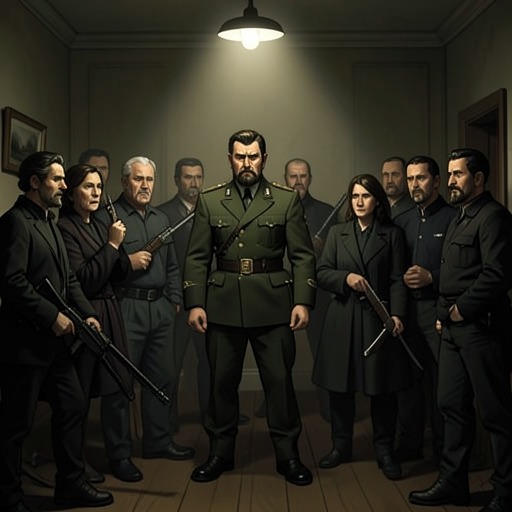
The narrator meets the General’s gaze while watching the mug in his hand, aware that he might have only a moment to react if the General struck him with it. His palms are damp; he is sweating so badly that, as he observes, only his eyeballs remain dry. When he asks whether military intelligence or the general staff might be relevant instead, the General returns to the demand for a name. The narrator understands that refusing to suspect anyone may itself look incriminating: in the General’s paranoid reasoning, denying that spies exist could make someone seem like a spy.
A deliberate diversion
Pressed to answer, the narrator searches for a suspect who will divert the General without being an actual spy. The crapulent major is the first name that comes to mind. The choice is tactical: the narrator does not present information linking the major to the communists, but offers a person whose name might move the General’s attention away from him.
The General’s reaction gives the diversion its immediate effect. He stops staring at the narrator and studies his own knuckles, distracted by the suggestion. He dismisses the major as an implausible candidate, making fun of his size and telling the narrator that his instincts are wrong for once. The narrator pretends embarrassment, gives the General his cigarettes to change the subject, and returns to the barracks. He reports the gist of the conversation to his aunt, omitting his fear and physical distress. The scene thus separates what the narrator says from what he knows: suspicion is being managed as a threat to survive, not pursued as a question to resolve.
From deflection to accusation
The later conversation with the General and Claude shows that the initial diversion has not remained merely a diversion. When the General announces that they have an informer, both men look toward the narrator as if awaiting confirmation. The narrator keeps his face impassive, but his stomach turns as the General names the crapulent major. The General says the narrator was the one who chose to bring the major with them, and describes that decision as a mistake for which he blames himself rather than the narrator. He says it is now time to correct it.
The General’s stated grounds are revealing but do not establish espionage. He points to the major’s Chinese ancestry, the prosperity of his family in Saigon, and his weight. The narrator challenges the racial inference directly, arguing that being Chinese does not make someone a spy. The General denies being racist while insisting that the family’s prosperity is suspicious because, in his view, the communists know the officers and their families and would not allow such a household to prosper without explanation. His certainty grows from suspicion and prejudice rather than demonstrated proof. The narrator’s earlier, intentionally unsupported name has supplied a convenient target, but the General’s later reasoning is his own.
A further exchange about a newspaper leak makes the uncertainty of the intelligence picture clearer. The General reads an article criticizing the Fraternity and its alleged armed movement, then concludes that someone has provided the newsman with reliable information. The narrator proposes a mundane source: Sonny could have collected separate bits of information by moving among the men, who each knew something about the operation. This account does not prove the major innocent, but it shows that information could escape through ordinary conversation, without identifying a single spy. The distinction between a leak and proof of a particular informer remains unresolved.
Recovered memory and complicity
The accusation’s deeper context emerges when the narrator’s memory is recovered during interrogation. He recalls the room called the movie theater, where Claude advised during the interrogation of a Communist agent and the crapulent major, nominally in charge, sat watching after leaving the questioning to three policemen. The narrator remembers objecting that what was happening was wrong and asking for time alone with the agent, but he also remembers watching rather than stopping the assault. The major’s presence in this scene does not prove the earlier spy allegation; it locates both men inside a coercive system in which information is extracted through abuse and responsibility is passed from one official to another.
The memory returns through concrete details: the policemen’s questions about the agent’s name, her attempt to identify herself as Viet Nam, and the bottle left inside her after the assault. The narrator describes the memory as sticky even after the room and table have been washed. This later recollection complicates the earlier act of redirecting suspicion. Narrator (Captain) was afraid of being identified as a spy and used the major’s name to protect himself, but his own account also preserves his failure to prevent violence when he witnessed it. The action is therefore both a small maneuver in a paranoid exchange and an early instance of a larger moral pattern: the narrator can recognize injustice, attempt a limited intervention, and still remain implicated in the machinery that produces it.